
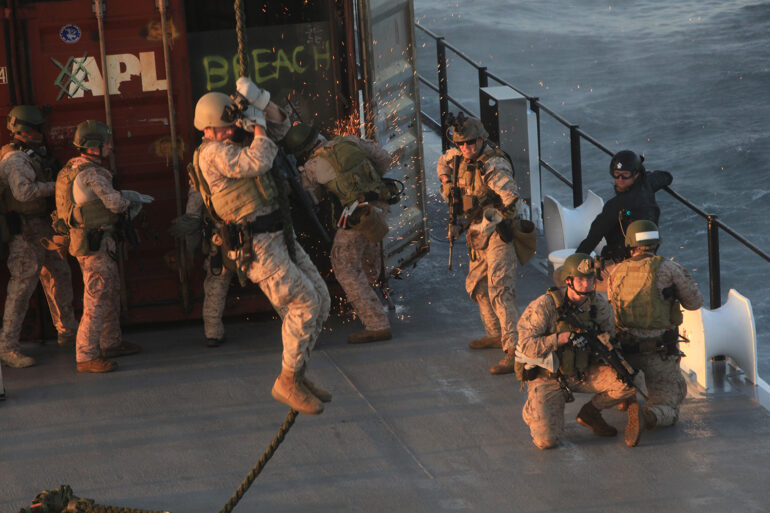

U.S. Special Forces reportedly carried out a high-stakes maritime interdiction in November, boarding a cargo ship in international waters in the Indian Ocean and securing dual-use goods being shipped from China to Iran, according to a report published by The Wall Street Journal on December 12.
U.S. officials described the operation as a targeted effort to slow Iran’s attempts to rebuild parts of its missile arsenal, underscoring Washington’s willingness to act far from shore to disrupt adversaries’ military capabilities.
Officials confirmed that the seized cargo had both military and civilian applications, a category broadly known as “dual-use goods.” While the items were reportedly removed and destroyed, some analysts speculated they may have been seized for further study. Given the wide scope of what can qualify as dual-use material, the precise nature of the cargo remains uncertain.
The operation, however, sends a clear signal. By interdicting a shipment originating in China and bound for Iran in international waters, the United States demonstrated a readiness to directly challenge supply chains that could aid hostile regimes. At the same time, the move raises concerns for Beijing’s trade interests, as a significant portion of Chinese industrial exports could theoretically fall under the dual-use designation.
Confirmation of the Special Forces action came just two days after U.S. forces on December 10 commandeered a civilian tanker in international waters that had been transporting Venezuelan oil for export. Together, the incidents point to a broader pattern of assertive U.S. actions targeting shipping linked to adversary states, as Washington applies pressure not only through sanctions but through direct interdiction at sea.
These actions are not without precedent. The United States has previously targeted civilian cargo as a tool of economic and strategic pressure. In the late 2010s, the U.S. Navy seized Iranian oil tankers, later selling the oil without compensating Tehran. Another notable case involved the North Korean cargo ship Wise Honest, which was seized by the U.S. Navy and sold, with the proceeds appropriated by the United States. European states have similarly expanded efforts against Russian shipping in response to Moscow’s actions.
What makes the China-to-Iran interdiction particularly significant is the potential scale of its implications. China is the world’s largest trading nation by a wide margin, and any sustained targeting of Chinese civilian exports would expose a major vulnerability in Beijing’s economic model. The presence of Western navies across key maritime corridors — including the Pacific, the Indian Ocean, and increasingly the Arctic — provides the U.S. and its allies with enormous leverage over global trade routes.

Chinese civilian ships have begun using the Northern Sea Route through the Arctic, an area where Western naval presence is also growing. That reality has fueled long-standing speculation about whether Western navies could eventually target Chinese shipping in international waters if relations continue to deteriorate. In 2020, the U.S. Naval Institute even floated the idea of hiring mercenary privateers to interdict Chinese shipping should tensions worsen.
For now, U.S. officials frame these operations as lawful and necessary steps to curb adversaries’ military ambitions. But the interdiction of China-linked cargo in international waters marks a notable escalation — one that highlights both America’s maritime dominance and the increasingly fraught future of global trade in contested seas.
[READ MORE: Pelosi Says No Grounds Yet to Impeach Trump Again, Tempering Democratic Calls for Another Showdown]